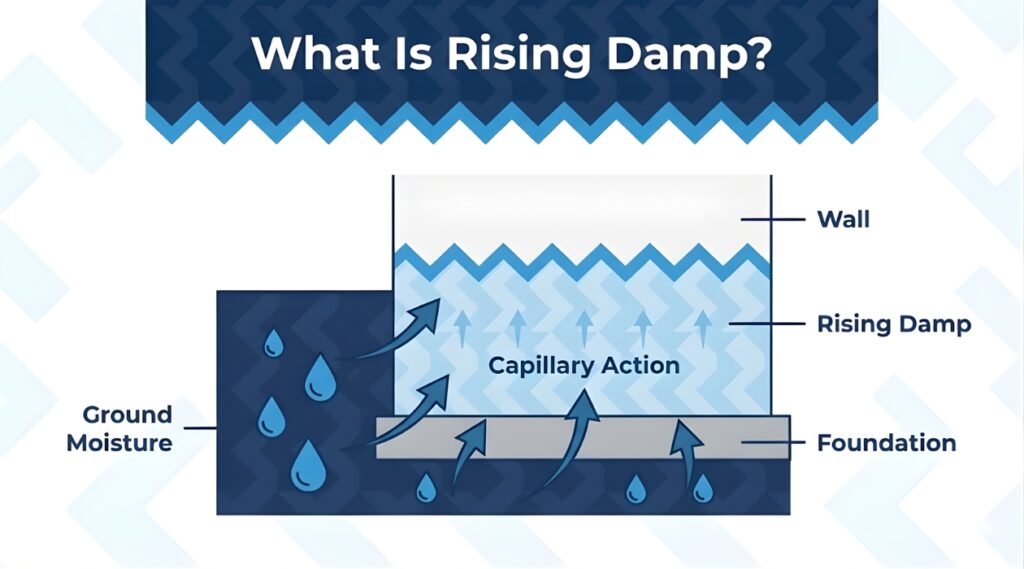
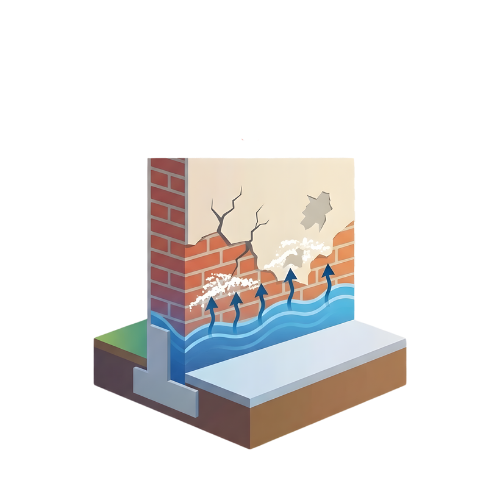
Rising damp is a serious moisture problem affecting many older apartment buildings, commercial structures, and high‑rise complexes across New South Wales. When groundwater travels upward through concrete slabs, masonry, or internal walls, it brings salts and moisture that can cause extensive deterioration—damaging finishes, corroding reinforcement, and accelerating structural decay.
For strata committees and building managers, early detection and correct treatment of rising damp is essential to avoid costly repairs, health risks, and long‑term asset degradation.
CPR specialises in diagnosing and treating rising damp in difficult‑access buildings using our patented Scaffold‑Free™ systems and AIMMS™ data‑driven inspection process, ensuring accurate identification and engineered, lasting repairs.

Rising damp occurs when groundwater moves upward through porous building materials such as brickwork, blockwork, or concrete slabs. This capillary movement introduces moisture and salts into internal walls, skirting boards, and flooring systems.
Understanding rising damp meaning is essential: it is not caused by leaks from above, but by moisture drawn up from below.
Common indicators include:
These signs of rising damp often appear long before the structural issues become visible.
If left untreated, rising damp can lead to significant long‑term issues, including:
Because rising damp affects the base of internal and external walls, early action prevents structural and cosmetic deterioration.
Rising damp can be misdiagnosed as water ingress or plumbing leaks. CPR uses AIMMS™—our proprietary inspection and mapping system—to identify the true cause.
Our assessment includes:
This precision provides clarity and prevents unnecessary or ineffective treatments.
Rising damp will not improve on its own. Early detection avoids structural deterioration, mould issues, and escalating strata repair costs.
Explore our full suite of building remediation and preservation services or learn more about our concrete durability repair solutions.