
Building inspection checklist in Australia is not just a formality — it is the foundation for protecting people, property value, and long-term budgets. For strata committees, building managers, and consultants, inspections often come with anxiety: What if we miss something? What if costs blow out later? What if we’re being oversold?
This guide exists to remove that uncertainty.
Below, we break down a complete, practical building inspection checklist in Australia, aligned with Australian building inspection requirements, real-world risk, and modern Scaffold-Free™ inspection methodology using AIMMS™ — CPR’s proprietary inspection and assurance system.
Why Building Inspections Create So Much Stress (And Why That’s Normal)
If you’re on a strata committee or responsible for a building, inspections can feel overwhelming.
- You’re responsible for other people’s money
- You may not have technical construction expertise
- Reports often feel vague, generic, or alarmist
- Different contractors say different things
That uncertainty creates fear of financial burden and distrust — especially when inspections lead to large remediation quotes later.
A proper building inspection checklist Australia framework removes guesswork. It replaces opinion with evidence, and short-term fixes with long-term clarity.
What Does a Building Inspection Include in Australia?
A comprehensive inspection should never be a quick walk-around.
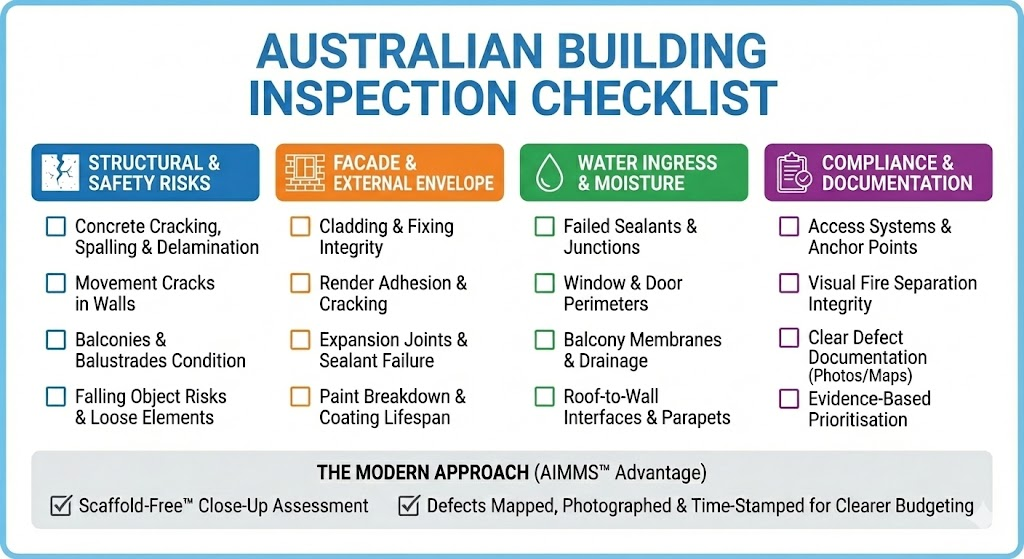
A building inspection report checklist must include:
- Visual and close-up assessment of all accessible building elements
- Identification of safety, structural, and compliance risks
- Clear documentation of defects, severity, and location
- Evidence-based prioritisation (what matters now vs later)
When inspections are performed under AIMMS™, every defect is recorded, mapped, photographed, and time-stamped — which means for you fewer surprises, clearer budgeting, and defensible decisions.
Australian Building Inspection Requirements: What Must Be Checked
Australian building inspection requirements vary by building type, age, and jurisdiction, but generally align with:
- NCC (National Construction Code)
- Relevant Australian Standards
- State-based WHS and building regulations
A compliant building compliance checklist Australia typically covers the following categories.
Structural Inspection Checklist Australia
Structural issues are high-risk and high-cost if ignored.
A proper structural inspection checklist Australia includes:
- Concrete cracking, spalling, and delamination
- Signs of concrete cancer or corrosion
- Movement cracks in masonry and rendered walls
- Load-bearing elements and transfer slabs
- Balconies, balustrades, and slab edges
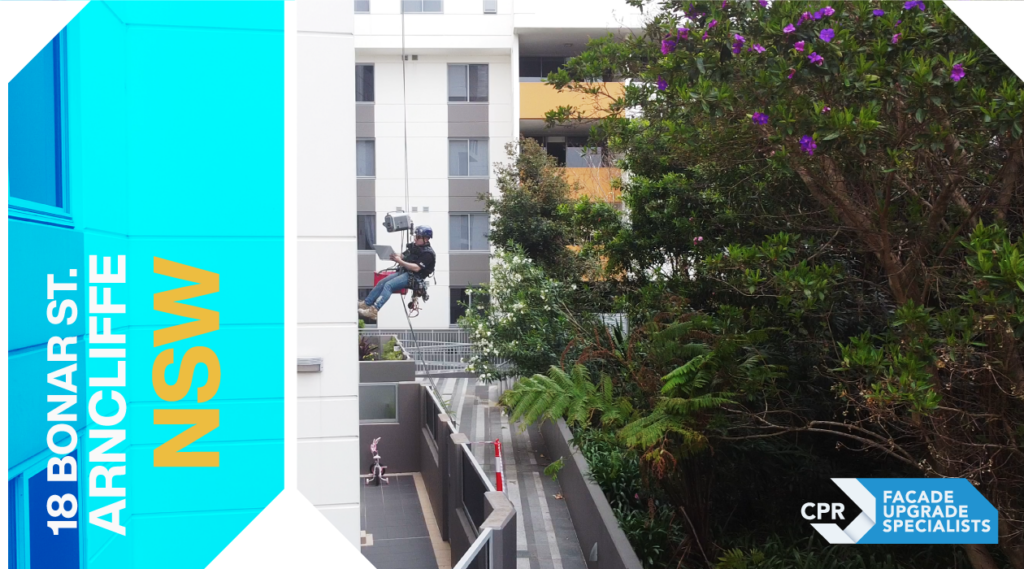
Using Scaffold-Free™ access via MARS™, PEARS®, and SkyPod®, CPR inspects areas traditional inspectors cannot reach — which means for you early detection without scaffolding costs or resident disruption.
Facade and External Envelope Checklist
The facade is your building’s first line of defence.
A complete checklist includes:
- Cladding condition and fixing integrity
- Render adhesion and cracking
- Expansion joints and sealant failure
- Paint breakdown and coating lifespan
- Water ingress pathways
Unchecked facade defects often lead to internal damage. AIMMS™ documents not just what is failing, but why — which means for you solutions that last decades, not years.
Water Ingress and Moisture Risk Checklist
Water is silent, expensive, and relentless.
A professional property inspection checklist Australia must assess:
- Failed sealants and junctions
- Window and door perimeters
- Balcony membranes and drainage
- Parapets and roof-to-wall interfaces
- Signs of internal moisture migration
By diagnosing moisture paths externally using Scaffold-Free™ systems, CPR avoids invasive internal inspections — which means for you faster answers with minimal disruption.
Safety and Compliance Checklist
Safety is not optional — legally or morally.
A building inspection standards Australia approach includes:
- Loose facade elements
- Falling object risks
- Balustrade compliance
- Access systems and anchor points
- Fire separation integrity (visual assessment)
All findings are logged within AIMMS™, creating an auditable safety record — which means for you defensible compliance if incidents or disputes arise.
Residential and Home Building Inspection Checklist Australia
For low-rise or strata residential buildings, a residential building inspection Australia checklist includes:
- External walls and finishes
- Roof coverings and drainage
- Balconies and common areas
- Shared services penetrations
This differs from a house inspection checklist Australia or Australian home inspection checklist, which often focuses on pre-purchase concerns rather than long-term asset protection.
Pre Purchase Building Inspection Checklist vs Ongoing Asset Inspections
A pre purchase building inspection checklist is designed to flag immediate red flags for buyers.
In contrast, a building inspection checklist for buyers does not replace a long-term maintenance or compliance inspection.
For strata and asset owners, relying on pre-purchase logic leads to reactive spending. AIMMS™ shifts inspections from reactive to strategic — which means for you predictable budgets and fewer emergency levies.
New Home Inspection Checklist Australia: What Still Gets Missed
Even new buildings are not immune.
A new home inspection checklist Australia should still assess:
- Defective finishes
- Early sealant failure
- Poor drainage detailing
- Construction shortcuts
Scaffold-Free™ close-up inspections often reveal defects missed during handover — which means for you accountability while warranties still apply.
Why Traditional Inspection Reports Fall Short
Many inspection reports:
- Are written from ground level
- Lack photographic consistency
- Provide vague recommendations
- Create fear without clarity
AIMMS™ changes that by providing structured defect mapping, severity ranking, and traceable records — which means for you transparency instead of confusion.
How AIMMS™ Transforms the Building Inspection Checklist Australia
AIMMS™ is CPR’s single inspection and assurance system.
It integrates:
- Scaffold-Free™ access
- Grid-based facade mapping
- Before-and-after photographic records
- Secure cloud documentation
This approach has supported 450+ major projects and contributed to award-winning outcomes, delivering up to 30% cost savings by eliminating unnecessary scaffolding — which means for you better value without compromise.
Long-Term Value: Inspections That Protect Budgets, Not Just Buildings
Inspections should not sell fear. They should sell certainty.
When inspections feed directly into long-term strategies like AssetCare™, buildings benefit from:
- Multi-decade remediation planning
- Reduced lifecycle costs
- Fewer emergency works
- Greater stakeholder confidence
Who This Checklist Is Really For
- Strata committees seeking peace of mind and affordability
- Building managers wanting efficiency and fewer complaints
- Consultants needing defensible, data-driven insights
AIMMS™ adapts to each — which means for you the right level of clarity without overload.
Book a Building Inspection the Smarter Way
If you’re reviewing or commissioning a building inspection checklist in Australia, don’t accept guesswork.
CPR offers Scaffold-Free™ inspections powered by AIMMS™, designed to reduce risk, minimise disruption, and protect budgets.
👉 Book a building facade inspection consultation, request an AIMMS™ demo, or explore our Scaffold-Free™ building inspection consultancy services designed for strata and complex buildings.