Drummy render is a widespread but often underestimated facade defect affecting high‑rise and strata buildings across Sydney and other metropolitan areas. Unlike surface cracking, drummy render indicates a loss of adhesion between the render and the underlying wall substrate.
When render becomes loose or delaminated, it creates hollow areas that compromise facade safety, durability, and compliance. Over time, this can lead to falling render risks, moisture penetration, accelerated facade deterioration, and escalating remediation costs.
CPR specialises in identifying and resolving drummy render and delamination in difficult‑access buildings using AIMMS™ — our data‑driven facade inspection and analysis system — combined with Scaffold‑Free™ access technologies to deliver precise, long‑term solutions with minimal disruption.

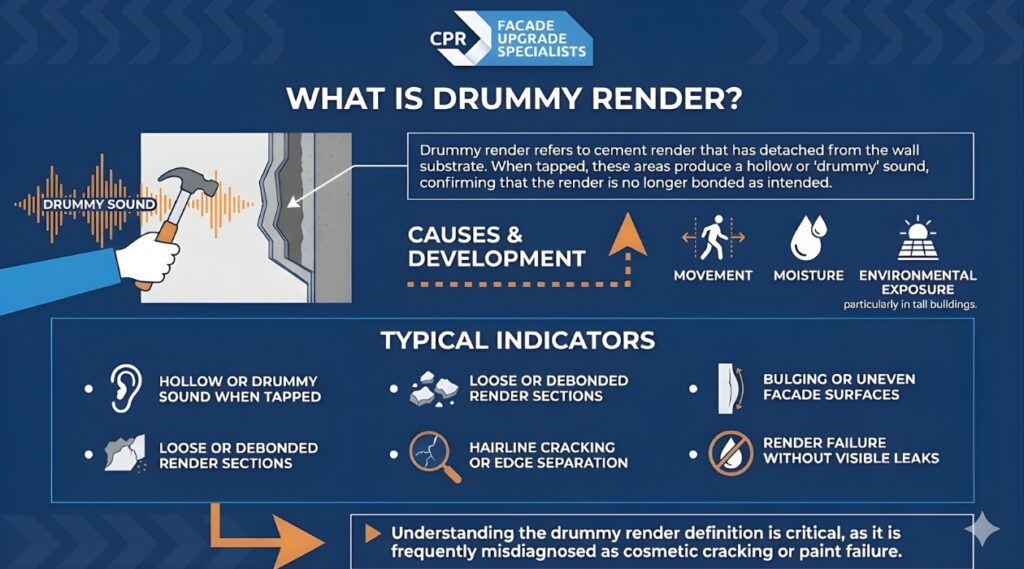
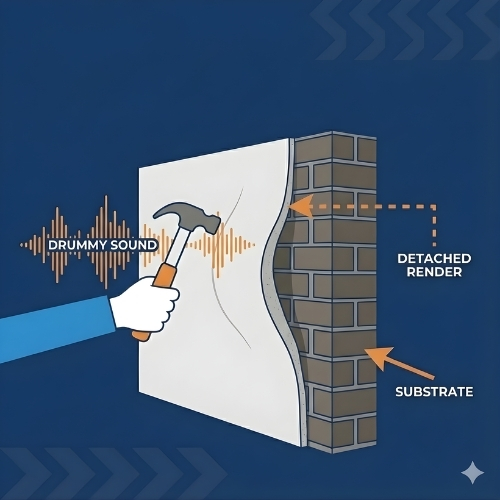
Drummy render refers to cement render that has detached from the wall substrate. When tapped, these areas produce a hollow or ‘drummy’ sound, confirming that the render is no longer bonded as intended.
This condition commonly develops over time due to movement, moisture, and environmental exposure, particularly in tall buildings.
Understanding the drummy render definition is critical, as it is frequently misdiagnosed as cosmetic cracking or paint failure.
In high‑rise and strata buildings, drummy loose render commonly develops on external walls where environmental exposure and building movement are greatest.
Over time, this can result in:
These issues are particularly common on older rendered facades, slab edges, window interfaces, and elevations exposed to sun, wind, and rain.
Drummy render is often incorrectly treated as a surface issue, leading to ineffective repairs. CPR uses AIMMS™ to accurately identify the extent, cause, and severity of render delamination — which means for you: clear answers, defined scope, and informed decision‑making.
Our diagnostic process may include:
This allows us to determine whether grouting drummy render, localised repair, or targeted render replacement is the most appropriate solution.
Drummy render rarely resolves on its own. Early assessment and targeted remediation are essential to protect facade safety, minimise liability, and preserve long‑term building value.