What are the building inspection stages? For strata committees, building managers, and consultants, this question almost always relates to external building inspection stages — not internal fit-outs or residential construction checks.
Understanding the external building inspection stages is critical for managing facade risk, preventing water ingress, avoiding cost blowouts, and protecting long-term asset value. External inspections follow a structured, methodical process focused entirely on the building envelope — the facade, structure, and interfaces exposed to weather and time.
This article explains the external building inspection stages, how each stage works, and how modern Scaffold-Free™ inspections powered by AIMMS™ deliver certainty, transparency, and peace of mind for strata, commercial, and high-rise buildings.
Why external building inspection stages matter for strata and commercial buildings
For strata committees, external inspections often feel high‑stakes. There is fear of hidden facade defects, concern about special levies, and anxiety around resident disruption. These concerns are justified — external building failures are among the most expensive and disruptive issues a building can face.
A clearly defined set of external building inspection stages removes uncertainty. Each stage builds on verified data, creating a defensible picture of facade condition — which means for you: informed decisions instead of reactive spending.
When external inspection stages are skipped or rushed, defects remain hidden until they become urgent, expensive problems.
Overview of the external building inspection stages
Unlike residential building inspections or internal construction checks, external building inspection stages focus exclusively on the building envelope and structural interfaces exposed to the elements.
A typical external inspection process includes:
- Pre‑inspection planning and risk assessment
- External facade visual assessment
- Close‑up facade inspection
- Structural external inspection
- Penetration and interface inspection
- External services inspection
- Water ingress and moisture pathway assessment
- Defect classification and prioritisation
- Code compliance inspection (external)
- Final reporting and asset planning
Using AIMMS™, these stages are delivered as a single, integrated inspection pathway — which means for you: no gaps, no duplication, and no guesswork.
Stage 1: Pre‑inspection planning and access assessment
Every external inspection begins with planning. This stage assesses building height, facade materials, access constraints, and safety risks.
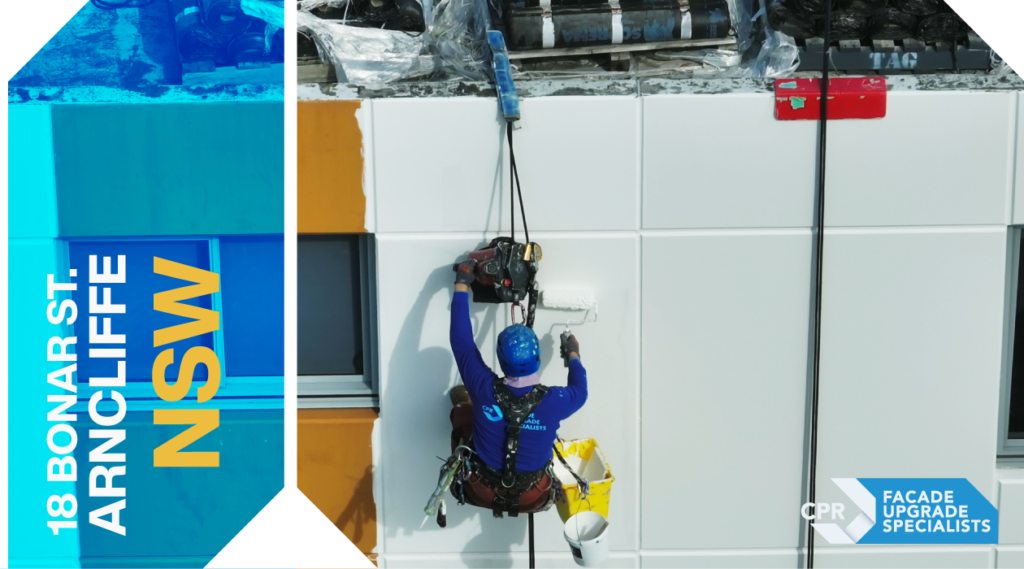
With AIMMS™, CPR determines the optimal Scaffold-Free™ access approach using MARS™, PEARS®, and SkyPod® — which means for you: inspections proceed without scaffolding, road closures, or resident disruption.
This stage sets the foundation for accurate timeframes, cost control, and safe execution.
Stage 2: External facade visual assessment
The first physical stage is a comprehensive external visual inspection of all elevations.
Inspectors identify visible cracking, spalling, coating failure, sealant breakdown, and movement indicators. While this stage is relatively fast, it is only the starting point — which means for you: early warning signs are captured, but not relied on alone.
Stage 3: Close‑up facade inspection
Close‑up inspection is where external inspections move beyond assumptions.
Using Scaffold-Free™ access integrated into AIMMS™, inspectors assess facade elements at arm’s length — including concrete, render, masonry, joints, and fixings.
This stage dramatically increases inspection accuracy — which means for you: defects are confirmed, not guessed.
Stage 4: Structural external inspection
Structural external inspections focus on load‑bearing elements visible from the facade, including slabs, columns, beams, and balconies.
Deterioration, corrosion risk, and movement are assessed in context with facade defects. AIMMS™ links structural findings directly to facade data — which means for you: root causes are identified, not just surface symptoms.
Stage 5: Penetration and interface inspection
Penetrations are one of the most common sources of facade failure.
This stage examines windows, doors, balustrades, services penetrations, and joints between materials. AIMMS™ documents each interface photographically and spatially — which means for you: water ingress pathways are traceable and defensible.
Stage 6: External services inspection
External services inspections assess electrical, plumbing, and mechanical elements that pass through or attach to the facade.
Poorly detailed service penetrations frequently compromise waterproofing. Scaffold-Free™ access allows these inspections without entering apartments — which means for you: privacy is maintained and disruption is minimised.
Stage 7: Water ingress and moisture pathway assessment
This stage connects visible facade defects to moisture movement.
Using AIMMS™, inspectors map how water travels through cracks, joints, and interfaces — which means for you: remediation targets the cause, not the symptom.
Stage 8: Defect classification and prioritisation
Not all defects carry equal risk.
AIMMS™ classifies defects by severity, urgency, and long‑term impact — which means for you: budgets are prioritised logically, not emotionally.
Stage 9: External code compliance inspection
External code compliance inspections confirm alignment with relevant Australian standards for facade safety, waterproofing, and durability.
AIMMS™ provides an auditable record that supports compliance, insurance, and governance obligations — which means for you: confidence during audits and future sales.
Stage 10: Final reporting and AssetCare™ planning
The final stage transforms inspection data into action.
Deliverables include:
- Photographic defect maps
- Quantified scopes
- Prioritised remediation pathways
- Long‑term AssetCare™ planning
Which means for you: inspections become a long‑term asset, not a one‑off report.
External inspections vs residential and construction inspections
Residential building inspections focus on habitability. Commercial construction inspections monitor build progress.
External building inspection stages are different. They focus on durability, safety, and lifecycle performance — which means for you: protection of shared, high‑value assets.
Why structured external inspection stages reduce costs
Skipping external inspection stages often leads to:
- Scope creep
- Budget blowouts
- Repeat remediation
A staged external inspection approach delivers cost savings through foresight — which means for you: affordable outcomes without compromise.
How Scaffold-Free™ inspections improve every external stage
Traditional access methods limit inspections.
By integrating MARS™, PEARS®, and SkyPod® into AIMMS™, CPR inspects every elevation safely and efficiently — which means for you: full coverage with minimal disruption.
When should you start an external building inspection?
You should begin the external inspection stages when:
- Water ingress appears
- Facade deterioration is visible
- Compliance deadlines approach
- Long‑term budgets are being planned
Early inspections prevent escalation.
Book an external building inspection with confidence
If you’re asking what are the building inspection stages, and your concern is the building exterior, you’re asking the right question.
AIMMS™ external inspections replace uncertainty with clarity and protect buildings for decades.
Book a building facade inspection consultation
Request an AIMMS™ demo to see how external inspection stages work in practice.